The 2026 edition of the Frontier 300 is planned for 29-30th May.
Introduction
The Frontier 300 gravel ride is a one-of-a-kind UK endurance challenge, stretching roughly 300km from Colvend on the Irish Sea coast in Galloway, Scotland, to Druridge Bay in Northumberland. This isn’t just about distance—it’s about navigating remote trails, forest tracks, and quiet country lanes that link Scotland to England. Along the way, riders encounter technical climbs, flowing fire roads, scenic descents, and even a steep hike-a-bike, making this a true endurance adventure rather than a simple long ride.
Table of Contents
- Introduction
- What is the Frontier 300?
- Route Breakdown
- What Makes It Unique
- Who This Event is For
- Pros & Cons
- My Frontier 300 Story (2024–2025)
- Training & Preparation
- Bike Setup & Kit
- Ride Strategy
- Day 1 Colvend to Kielder
- Day 2: Kielder to Druridge Bay
- Frontier 300 FAQ
- How Hard Is the Frontier 300?
- The Hike-a-Bike Explained
- Final Thoughts

What is the Frontier 300?
Organised by Focal Events, the Frontier 300 offers both a one-day and a two-day format, and new for 2026, a tarmac version. The one-day version is a true test of stamina, covering the full 300km in a single effort, while the two-day format spreads the distance into ‘manageable sections’ with overnight support and luggage transport.
The route is renowned for its variety. Riders face smooth forest roads, loose gravel tracks, quiet country lanes, and technical sections that demand concentration and bike-handling skills. Navigation is primarily via GPX, so self-sufficiency and map-reading skills are essential. Feed stations, checkpoints, and event support help riders manage the distance safely, but this is very much a ride where preparation and resilience matter.
The Frontier 300 is more than a race; it’s a coast-to-coast journey that blends endurance, technical challenge, and scenic landscapes—earning its place among the UK’s top events listed on the Gravel Endurance gravel events page.
Route Breakdown
The Frontier 300 route covers approximately 300km with around 4,200 meters of climbing. Starting on the Irish Sea coast at Colvend, riders traverse a mix of quiet country roads, flowing forest tracks, gravel fire roads, and one notorious hike-a-bike section before finishing on the Northumberland coast at Druridge Bay.

The terrain constantly changes, keeping riders engaged and challenged throughout. Every kilometre offers a new experience, whether it’s a technical gravel descent, a smooth fireroad to settle into a rhythm, or a climb that tests stamina and focus.
What Makes It Unique
Several elements set the Frontier 300 apart from other gravel rides:
- Distance and endurance: Covering 300km over mixed terrain is a serious test of stamina and mental toughness.
- Varied terrain: From smooth fire roads to rocky gravel trails, riders must adapt constantly.
- Coast-to-coast adventure: Traversing Scotland to England, the ride showcases some of the UK’s most scenic and remote landscapes.
- Community and support: Event staff, fellow riders, overnight logistics, and the post-ride celebration create a shared experience that’s memorable beyond the miles.
This combination of physical, technical, and mental challenges makes the Frontier 300 a standout event in the UK gravel calendar.
Who This Event is For
The Frontier 300 suits riders who crave a long-distance challenge but is accessible to a range of cyclists:
- One-day format: Ideal for experienced endurance riders seeking to push their limits and cover the full 300km in a single effort.
- Two-day format: Perfect for those wanting to spread the ride over two days, enjoy the scenery, and take advantage of overnight support.
- Terrain lovers: Anyone who enjoys varied surfaces—from gravel tracks and forest trails to technical descents and a hike-a-bike section.
Ultimately, this ride appeals to cyclists seeking an unforgettable adventure that challenges both body and mind while fostering camaraderie along the way.
Pros & Cons
Pros:
- Some of the UK’s most scenic and varied gravel terrain.
- Tests endurance, mental resilience, and bike-handling skills.
- Support stations, overnight logistics, and community atmosphere enhance safety and enjoyment.
- The post-ride celebration adds a rewarding social element.
Cons:
- Demanding: 4,200 meters of climbing and technical gravel sections.
- Requires careful planning for food, hydration, and bike setup.
- Punctures, mechanical issues, and navigation errors can turn a great ride into a tough day if unprepared.
The Frontier 300 is a truly remarkable gravel adventure. From the rolling hills of Galloway to the Northumberland coast, it delivers technical trails, flowing fire roads, and quiet lanes that make every pedal stroke rewarding. The hike-a-bike section becomes a memorable marker of the journey, reminding riders that this is about more than just distance—it’s about challenge, scenery, and shared experience.
Preparation is key: think about bike setup, tyres, navigation, food, and hydration. Whether attempting the one-day ultra or the two-day version, the Frontier 300 rewards careful planning, resilience, and a spirit of adventure.
How I Ended Up Riding the Frontier 300
I first heard about the Frontier 300 in late 2023 while researching gravel races and endurance events for the 2024 season. The event has been running since 2022 and organised by Focal Events, the team behind the Dirty Reiver. One view of the video below was enough to sell it to me.
I’ve always liked the idea of being an ultra-endurance athlete, even if the evidence didn’t fully support that belief yet. I signed up for two big events in 2024: the 200km Dirty Reiver and the one-day, 300km Frontier 300. I did this with no history of long-distance gravel racing. My background consisted of a couple of road/tarmac century rides and the completing Ballach na Bà endurance race back in 2018. Confident—or naïve—I gave myself four to six months to get fit for both.
The 2024 Dirty Reiver didn’t go to plan.
I was riding well early on, averaging around 15km/h, when I flatted after just 40km. I was running tubes at the time and tried swapping in a couple of spares, but the tyre refused to hold air. I was close to the first checkpoint, so I waited there and eventually got a lift back to the start/finish at Kielder Castle. I left with my tail between my legs, already promising myself I’d return in 2025.
After the 2024 Reiver, I made a few changes. I upgraded my gravel bike from a Lapierre to a Cervélo Áspero, running 38mm tyres on stock Fulcrum wheels. It felt like a step in the right direction.
Because the Frontier 300 is a point-to-point route, both me and my bike needed transporting to the start in Colvend, along with somewhere to stay the night before.
When you enter the event, there’s an option to book a coach and bike transfer from Druridge Bay to Colvend. Bikes need to be packed into either a bike box or a cardboard box. The transfer costs around £50 and can be booked for Thursday (for the two-day event) or Friday (for the one-day event). Riders travel by coach, while bikes are transported separately in a van.
Tip: Ask your local bike shop for a cardboard bike box—they’re usually happy to help. The boxes can be discarded at Colvend.
The coach drops riders at Colvend Village Hall, which acts as the event hub. The Focal Events team are there to handle registration, issue satellite trackers, and hand out a few goodies. Bikes typically arrive an hour or so later, and there’s a mechanic on site if anything needs attention.
If you don’t use the coach transfer, the nearest train station is Dumfries, with connections to both Glasgow and Carlisle.
Accommodation options around Colvend are varied. You can camp in the field opposite the village hall, stay at local campsites, or book a B&B or hotel. I stayed in Dalbeattie, about a 30-minute ride from the start. There are also plenty of suitable spots for campervans if that’s your setup.
Tip: Book accommodation early—it fills up quickly.
Food options in Colvend are limited but acceptable. There’s a pizza van in the village hall car park serving freshly cooked pizzas, and a small shop next to the hall where you can pick up basic supplies. If you’re camping overnight, it’s worth bringing food with you. There’s also access to a microwave in the village hall.
On the morning of the ride, riders return to the village hall to grab a coffee, use the toilets, and make final preparations (you’ll need to bring your own breakfast). Once ready, it’s time to roll down to the official start in Rockcliffe, a couple of downhill kilometres away.
Kickback Coffee are set up in the Barcloy Road car park, where riders gather before the start. It’s a chance for one last caffeine hit, a (quiet) chat with fellow riders, and a moment to steady the nerves before rolling out past Rockcliffe Beach and into the first wooded section at Dalbeattie Forest.
The two-day event starts on Friday morning at 5:00am, while the one-day event begins on Saturday at 4:15am.
In 2024, I arrived at the start without a real ride plan. My only goal was to finish. Looking back, that was a mistake. A plan matters—something I’d only truly appreciate once the ride was underway.

Frontier 300 Ride Plan: Training, Bike Setup, nd the First 110km
In my 2024 Frontier 300 attempt, I arrived at the start line with one simple goal: finish. There was no pacing strategy, no structured ride plan, and very little thought given to how I’d manage my energy—physically or mentally—over 300km. Unsurprisingly, that approach caught up with me.
By the time I returned in 2025, my mindset had changed. I wasn’t just fitter; I was more realistic. The lessons from my 2024 DNF, combined with what I learned at the Dirty Reiver earlier in the year, made one thing clear: I wasn’t ready to complete the Frontier 300 in a single day. Switching to the two-day format wasn’t a compromise—it was a deliberate decision based on my fitness level at the Dirty Reiver, only 2 months before the Frontier 300.
Preparation & Training: Learning the Hard Way
The biggest difference between my 2024 and 2025 attempts wasn’t motivation—it was preparation.
In 2024, I simply wasn’t ready. Physically, I hadn’t done enough long-distance riding. Mentally, I didn’t fully understand what I’d signed up for. There was no real pre-event planning, and once fatigue set in, doubt followed quickly.
For 2025, I took a more structured approach. I trained using a combination of indoor and outdoor riding, gradually increasing weekly long distance ride by around 25km. In the build-up to the Dirty Reiver, I completed several 100km+ rides, and I continued with long-distance efforts after finishing the 120km Reiver route.
That said, one mistake still stands out: I didn’t do enough back-to-back long days. My longest ride before the 2025 Frontier 300 was 120km, and I hadn’t trained my body to recover overnight and ride long again the next day. That’s a major consideration for anyone deciding between the one-day and two-day formats. If you haven’t practised riding long distances on consecutive days, the fatigue will find you. It certainly found me.
The key lesson here is simple: overall training volume matters, but specificity matters more.
Bike Setup: Comfort, Simplicity, and Fewer Mistakes
For the 2025 Frontier 300, my bike setup prioritised comfort, reliability, and simplicity over marginal gains.
- Bike: Cervélo Áspero
- Drivetrain: 1x
- Wheels: Zipp 303s carbon
- Tyres: Panaracer GravelKing X1, tubeless (Front: 45s; Rear 40s).
After my Dirty Reiver experience, running tubeless was a non-negotiable.
Luggage: A Lesson in Overpacking
My luggage setup evolved significantly between attempts—and even between days during the 2025 ride.
2024 setup (far too much):
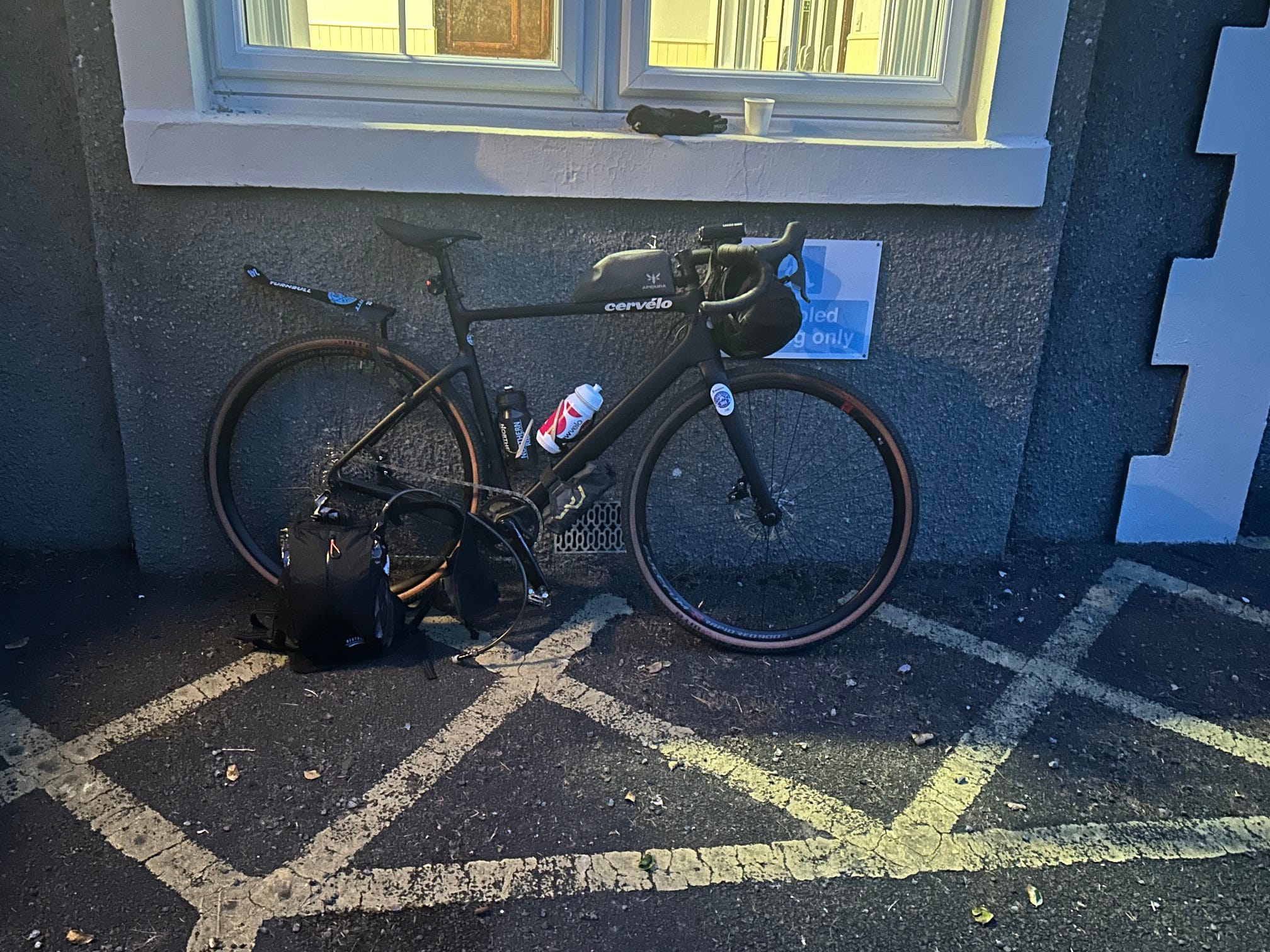
I carried far more than I needed “just in case,” and the weight punished me over distance. The handlebar pack was complete overkill, and I removed it and handed it to an Event staff member to return to the finish at the 2nd Feed Stop. The downtube tool kit was also more than I needed. I do like the idea of the Downtube pack, however, I overpacked and it got in the way when pedalling. You do need to pack a tool kit, but not as much as I did first time. I’ll list tool kit suggestions below.
2025 Day 1:
- Restrap hydration pack (extra clothing, food, layers — very heavy)
- Top tube bag
2025 Day 2:
- Tailfin frame bag
- Top tube bag
On Day 2, I ditched the Hydration pack and replaced it with the Tailfin frame pack (pictured below). My back was suffering after Day 1, and I was easily able to pack the same amount of kit in the frame pack. The bike felt lighter, easier to manage, and more responsive on tired legs. If there’s one takeaway here for future Frontier 300 riders, it’s this: pack less than you think you need. There’s food at the feed stops and the route passes through towns and villages if you need to visit a shop.

Tip: Plan a pre-event ride carrying/wearing your event kit to get used to fit and weight.
The Ride Plan: Breaking 300km Into Manageable Pieces
The biggest change in 2025 was having an actual plan.In 2024, my ‘plan’ was simply to finish. In hindsight, that wasn’t a plan at all. For 2025, I structured the ride around feed stops:
- Day 1: 3 × 60km efforts
- Day 2: 2 × 60km efforts
This approach changed everything. I wasn’t riding 300km—I was riding to the next checkpoint.
Pacing Strategy
Rather than riding by power or heart rate, I paced the ride at roughly 15km/h. It wasn’t about speed; it was about endurance. Riding within myself early meant I could arrive at each feed stop tired but functional, rather than completely depleted.
Fuelling followed the same philosophy: eat regularly, carry what I needed between feed stops, and avoid relying on willpower alone.
The First 110km: Where the Plan Started to Matter
Rolling out from Rockcliffe in the early morning, I felt the usual nerves—but this time they were controlled. The early kilometres through Dalbeattie Forest felt manageable. I wasn’t chasing wheels or worrying about position. I was riding my plan.
Breaking the route into 60km sections kept my focus narrow. Each segment had a clear start, a clear finish, and a clear purpose. I rode with another rider, chatting until arriving at the first Feed Stop at the Forest of Ae Bike Shop & Cafe (after 60km). The cafe ( https://share.google/x86C2FhtdP0XANBQX) was open, so I stopped and had a coffee and a snack before heading off. I was on time, and feeling ok in myself.
Tip: if you get bitten by midges, take an antihistamine tablet early as the midges can strike at the 1st Feed Stop. Kielder is also notorious for midges, so carry some antihistamine tablets with you. I was ‘eaten alive’ in 2025 and wish I’d taken a tablet before riding into Kielder.
From the feed stop, the route heads into the hills and towards the hike-a-bike and the high spot of the journey. I punctured on a descent, and swapped in a tube. I was a little behind schedule but I was happy with my performance. When reaching the second feed stop at around 110km at Eskdalemuir, I felt a mix of everything:
- tired but in control
- stronger than expected
- relieved to stop
- confident I’d made the right decision choosing the two-day format
Compared to 2024, the difference was massive. I was in relatively good shape, I wasn’t too far behind my schedule, even with a puncture, and my plan was working.
I’ll write about the hike-a-bike in a future article, for those interested.
The Difference This Time Was Simple
Up to 110km, my plan worked—the high point of the route and the hike-a-bike out of the way, the big climbs I’d experienced in 2024 were done and I had only 60-70km to do. I was getting flashbacks to 2024, mostly big ascents that I still had to ride!
But for me, the difference in 2025 was simple: I had a plan, and I stuck to it.
Tip: If you’re considering the Frontier 300, whether as a one-day ultra or a two-day endurance challenge, take the time to prepare a plan – from your pre-event training to fuelling strategy and race plan. You’ll be grateful you did.
Frontier 300 Ride Report (110–180km): Crossing the border and overnight in Kielder.
After 110km, everything changes
Reaching the second feed stop at around 110km feels like an achievement—and it is—but it’s also where the Frontier 300 begins to change character. You’ve passed the highest point of the route and have completed the hike-a-hike. You’ve pulled into the 2nd Feed Station at Eskdalemuir Village Hall, taken time to replenish, refresh and relax. The 2nd Feed Station is manned by the team at Raw Velo, with plenty of their products on hand to keep you going.
You’ve done the hardest bit, now enjoy the ride and get to Kielder.
From Eskdalemuir, it’s a 20km ride into Langholm (on tarmac), which gives you time to relax a little more. From Langholm, it’s an uphill and then a long exhilarating tarmac downhill into Newcastleton. You’ll pass half distance (150km) on the route as you cycle into the village.
There’s a shop in Newcastleton to stock up on provisions if needed, then it’s the push towards the next stop. If you are susceptible to midge bites, take an antihistamine at this point! From Newcastleton, it’s an off-road 30km into Kielder; 15km uphill, 15km downhill. Starting with a fun twisty uphill following the 7 Stanes Red Route at Rock UK – you cross the border into England at 160km.
The final 15km is downhill until you hit the banks of Kielder water at 175km. Follow the side of the reservoir until reaching the village and then follow the signs to Kielder campsite, the overnight stop for 2 Day riders, and Feed Stop 3 for those on the 1 day ride.
Congratulations, you’ve got 180km in the bank.
The sense of achievement as you ride into the campsite is immense. Time to put up your tent, take a hot shower and change your clothes. Food is available, and delicious – there may be a beer or two available. For the riders on the overnight stay it’s a relaxed atmosphere, with a number of event sponsors on hand to help and talk through the day’s adventures.

The team from Fenwicks Bike have a tent set-up at the Kielder campsite. Leave your bike with them and they’ll wash and lube it for you. If you have bigger problems, they’ll do their best to help you.
My bike sounded horrible when arriving at the campsite, and I was grateful for Fenwicks, after a long day in the saddle, that I didn’t have additional maintenance to do. Check the FAQ section for suggested toolkit.
Kielder at 180km: A Line in the Sand
At around 180km, Kielder marks more than just another point on the route. In 2024, this was where my ride ended. In 2025, it was a reset—a place to reassess, regroup, and prepare for what was still to come.
I can hardly remember rolling into Kielder campsite in 2024. I was in a different world, and suffering massively. I had underestimated the event, and overestimated my ability and fitness. I paid the price. Up to 160km, I was planning on carrying on and attempting to finish in 1 day, but made the tough decision to bail on the climb out of Newcastleton. My thanks go out to Stephen, the sweep from Focal Events, who escorted me for approx. 100km. I’d have not made it to Kielder without his patience and bad jokes. At Kielder, I was fed some soup and then got a lift back to Druridge Bay with Simon, again from Focal. I appreciate the support the team gave me.
I was in a better place in 2025. I’d learnt a lot from my 2024 experiences, and paced myself accordingly. I knew beforehand that 300 km in either form – 1 day or 2 days, is still a massive challenge, and it puts a different strain on you.
I ate my dinner at Kielder and slid into my tent. The midges were unbearable, and staying outside meant I was going to become their evening meal. My airbed was inflated, my sleeping bag ready and sleep was easy to find.
Lessons Learnt – Day 1
The Frontier 300 isn’t hard because it’s brutal—it’s hard because it’s unforgiving. Saying that, by the time you reach 180km, there’s a sense of achievement in completing a big ride through Scotland and into England. For the 2 dayers, the overnight stop at Kielder gives you the opportunity to talk to your fellow competitors about the day, the route, the scenery and the massive gravel cycling challenge that you’ve just completed.
Day 2 looks easier – 120km into Druridge Bay with 1900 metres of climbing was on the books. From my 2025 experience, it isn’t!
In the next article in this Frontier 300 series, I’ll cover what happens after Kielder—overnight recovery, Day 2 differences, and riding into Druridge Bay.
Over the coming weeks, I’ll also be publishing a dedicated Frontier 300 FAQ and practical rider tips articles, covering everything from transfers and accommodation to kit, pacing, and common mistakes — if you’re planning a future attempt, it’s worth subscribing to Beyond Tarmac so you don’t miss them.
Day 2 – Riding from Kielder to Druridge Bay
After a long Day 1 and an overnight stop at Kielder, the Frontier 300 resumes on Saturday morning for the final 120km into Druridge Bay. Although shorter than Day 1, the distance, accumulated fatigue, and rolling terrain make it a significant challenge. Mentally and physically, Day 2 demands focus, patience, and resilience.
Overnight Recovery at Kielder
I woke around 6am, ready to start riding by 8am. Breakfast was excellent (as you can see), and I took another shower before tackling the tricky task of washing & drying my cycling kit. While Kielder campsite offers washing machines and dryers, tokens are needed — I hadn’t purchased any, so I improvised using the hand driers.
Tip: Pack an extra set of bibs shorts and jersey!

Sleep had been restorative thanks to my midge-free tent, double-sized airbed, and sleeping bag. It was exactly what I needed to prepare for the day ahead.
Day 2 Bike and Luggage Setup
Day 2 required some adjustments. My hydration pack from Day 1 had been far too heavy, loaded with water, gels, bars, and spare equipment, which caused back pain. On Saturday morning, I swapped in a Tailfin frame bag and redistributed my kit between the top tube bag and the frame pack (as below). My setup felt lighter and more manageable, giving me confidence to tackle the day.

Rolling Out from Kielder
Although the distance and climbing were less than Day 1, Day 2 was still a significant test — 120km with roughly 2000 metres of climbing. I’d also imposed a mental ultimatum: if I didn’t make it to Druridge Bay under my own steam, I’d give up cycling.
In hindsight, unwanted pressure.
The ride started with heavy rain, making focus essential. Despite the challenges, I was determined to finish.
Route Highlights
From Kielder, the route passes Bellingham, then enters Harwood Forest. Early on, even before leaving Kielder, I experienced a mechanical scare: my front wheel thru-axle had worked itself loose. Luckily, I noticed before a descent and tightened it, avoiding a potential crash.


A navigation error added 7–10km and about half an hour to the ride, but a quick stop at a Co-op in Bellingham (approx 210km) for some Haribo helped restore energy and morale.
Stopping at the third feed station at West Woodburn (Corsenside Parish Hall at 225km) was a welcome respite, especially as the rain was tipping it down. Sandwiches, sweets, and biscuits provided a much-needed energy boost, though the steep climb immediately out reminded me that the day was far from over.
From the feed stop, it’s 15km of rolling hills, including Winter’s Gibbet, which is a tough climb in itself, followed by 15km of gravel through Harwood Forest and the high point of Day 2. There’s roughly 50km to the finish line, the climbs coming thick and fast.
Final Stretch to Druridge Bay
Onto a 20km section through Longframlington. There were some big climbs to tackle – every ascent tested my legs, but knowing that the remaining route flattened toward the coast was motivating.
The last 10km past Felton is relatively flat, a welcome relief as I was also having to deal with the relentless rain. Closing in on the coast, the rain paused, revealing a rainbow as I approached the finish — a perfect symbol of the effort and struggle behind me.

Cycling over the line at Druridge Bay was an emotional moment. Event sponsors and volunteers were in place, clapping riders over the line. The atmosphere was celebratory, supportive, and genuinely joyful. After 300km coast-to-coast, I felt a mix of exhaustion, relief, and elation.
I’d brought an extra tent with me, and had put it up on Thursday before setting off for Scotland, saving myself the task of erecting a tent after riding 300km. I’d been overtaken by the leaders of the 1 day ride, but having finished, probably last of the 2 day riders, I didn’t care. I’d finished!
I took another warm shower, grabbed some food and gently made my way back to my tent. 1 day riders were finishing throughout the night, and event staff rang a bell whenever a rider crossed the line. A verbal celebration.
Day 2 Lessons Learnt
Day 2 of the Frontier 300 proved that distance alone doesn’t define challenge — accumulated fatigue, weather, mechanical issues, and mental pressure all contribute. Every pedal stroke mattered, and reaching Druridge Bay under my own power was a huge personal victory.
If you’re considering the Frontier 300, remember: preparation, pacing, and mindset are just as important as fitness.
Everything You Need to Know Before Riding the Frontier 300

The Frontier 300 is one of those events that raises more questions the deeper you look into it. From kit choices and pacing, to food, logistics and what really happens after 180km, there’s a lot to consider before you roll off the start line.
This FAQ brings together the most common questions I had before riding the Frontier 300, one of the UK’s most demanding gravel ultra events—along with the lessons learned from riding (and not finishing) in 2024, and completing the two-day event in 2025. Whether you’re planning your first ultra, choosing between the one-day or two-day format, or simply want a clearer picture of what to expect, this guide is designed to help you prepare with confidence.
Frontier 300 – Frequently Asked Questions
EVENT OVERVIEW
FAQ 1: What is the Frontier 300?
The Frontier 300 is a coast-to-coast gravel endurance ride from the Solway Firth in Scotland to the Northumberland coast in England.
FAQ 2: Is the Frontier 300 a race?
No — it’s not officially a race. However, elite riders do take part and there is an element of racing at the front. For most riders, it’s a personal endurance challenge.
FAQ 3: How long is the route?
The route is officially 300km, which gives the event its name.
FAQ 4: What is the route?
The event starts in Rockcliffe (near Colvend), heading east through Dumfries, Langholm and Newcastleton, crossing into England before reaching Kielder. From there, the route passes through Bellingham and Longframlington, reaching and finishing on the Northumberland coast at Druridge Bay Country Park.
FAQ 5: Who organises the Frontier 300?
The event is organised by Focal Events, the team behind Dirty Reiver, Dalby Grit and GravelRocks.
EVENT FORMAT & DIFFICULTY
FAQ 6: Are there different route options?
Yes. There’s a 300km All-Road route (approximately 150km gravel) which can be completed in one or two days.
A road-only 300km route has also been introduced for 2026.
FAQ 7: Is the Frontier 300 supported?
The event is fully organised with feed stops, tracking, and overnight logistics — but riders must be self-sufficient on the route. You’re expected to carry tools, spares, clothing and nutrition between stops.
Top Tip:
Treat the event as semi-supported. Help exists, but you need to solve your own problems first.
FAQ 8: When does the event take place?
The two-day event starts on Friday 29th May.
The one-day event starts on Saturday 30th May.
FAQ 9: Is the Frontier 300 suitable for first-time ultra riders?
Yes. With proper training and preparation, it’s achievable.
The one-day event is a very big challenge; the two-day event is more manageable but still demanding.
Top Tip:
Choose the format based on current fitness, not ambition.
FAQ 10: How hard is the Frontier 300?
It’s physically and mentally challenging. It’s not brutal — but it’s unforgiving. Fatigue accumulates quickly and mistakes compound over distance.
TRANSPORT, TRANSFERS & LOGISTICS
FAQ 11: How do I get to the start?
You can book the official coach and bike transfer from Druridge Bay to Colvend. Alternatively, riders may arrange their own transport. Dumfries has a train station with links to Glasgow and Carlisle.
FAQ 12: How much does the official transfer cost?
Approximately £50–£75, which includes bike transfer and parking at the finish village.
FAQ 13: How are bikes transported?
Bikes must be packed in a bike bag or box. Cardboard boxes can be sourced online or from local bike shops. Boxes can be disposed of at Colvend Village Hall.
FAQ 14: What happens to my luggage?
Luggage travels with you on the coach, then onward to Kielder (two-day riders) or back to Druridge Bay. A large duffel bag is recommended.
Top Tip:
Pack less than you think you need — especially for on-bike luggage.

Image courtesy of Focal Events
ACCOMMODATION & FOOD
FAQ 15: Where can I stay near the start?
There’s plenty of accommodation around Colvend and Dalbeattie. Booking early is strongly recommended.
FAQ 16: Is camping available at the start?
Yes — free camping is available in the field opposite Colvend Village Hall, with limited facilities.
FAQ 17: What’s the overnight setup for two-day riders?
The overnight stop is at Kielder Campsite, with catering, toilets, showers and an event village atmosphere. The cost is included in the 2-day entry fee.
Top Tip:
Midge spray, antihistamine and a head net are essential at Kielder.
FAQ 18: What food is available during the event?
Feed stops are spaced roughly every 60km:
- 60km: Forest of Ae Bike Shop & Café
- 110km: Eskdalemuir Village Hall (Raw Velo)
- 180km: Kielder (soup / evening meal)
- 224km: Corsenside Parish Hall (sandwiches & snacks)
Riders should also carry their own food between stops.
BIKE SETUP, KIT & MECHANICALS
FAQ 19: What bike setup works best?
Gravel bikes are ideal. Wider tyres improve confidence and comfort.
Top Tip:
45mm front & rear tubeless felt far more stable than narrower tyres.
FAQ 20: What’s the minimum mandatory kit?
Riders must carry:
- GPS head unit
- Whistle
- Survival blanket / bivvy bag
- Waterproof jacket
- Warm layers
- Full leg cover
- Lights (front & rear)
- Mobile phone
- Food & water capacity (1.5L+)
- Tools, spares, pump, lube
Riders without mandatory kit will not be allowed to start.
Top Tip:
Do a full kit shakedown ride at least once before race week.
FAQ 21: What tools should I carry?
At minimum:
- Tubeless plugs
- Mini pump / CO₂
- Tyre levers
- Multi-tool with chain breaker
- Spare quick link
- Chain lube
- Sealant
- Inner tube
Fenwicks and Tailfin support is available overnight at Kielder.
RIDING STRATEGY & MINDSET
FAQ 22: What pacing strategy works best during the ride?
Pacing is personal. A steady approach (e.g. ~15 km/h) helps avoid early burnout.
Top Tip:
Ride to the next feed stop, not the finish. Do not stay too long at the feed stops – the time adds up.
FAQ 23: Should I ride alone or with others?
Both happen. Riding with others can help mentally, especially on Day 1.
FAQ 24: What’s the hardest part of the event?
For many riders, Day 2 — fatigue accumulates and recovery matters. In terms of the route, the section between Feed Stop 1 and Feed Stop 2 is ‘lumpy,’ and includes the hike-a-bike climb.
FAQ 25: What’s the finish like?
Druridge Bay has a lively finish village with food, coffee, bar, showers, camping and a celebratory atmosphere. Finishers are cheered over the line — even late into the night.
FAQ 26. Is mechanical support available?
The event is self‑supported. Fenwicks and Tailfin provide assistance at Kielder, and a bike shop is nearby. The event team/sweep can offer limited help.
Pacing, Strategy & Difficulty
FAQ 27. How should I structure my day around feed stops?
Pacing is personal. Many riders target around 15km/h and break the route into manageable 60km sections between feed stops.
FAQ 28. How hard is the Frontier 300?
It is physically and mentally demanding. Significant training and preparation are required.
FAQ 29. What should I bring to deal with midges at Kielder?
Midges can be relentless, especially in the evening when you’re trying to recover, eat, or set up camp. At a minimum, bring a strong insect repellent (such as Smidge or DEET-based spray). A head net is highly recommended. Long sleeves and lightweight layers also help reduce exposed skin. Try the Smidge website here: https://www.smidgeup.com/
FAQ 30. Is planning important?
Yes. Creating and refining a plan, training properly, and breaking the route into sections makes the challenge more manageable.
Finish Line & Recovery
FAQ 31. What is the finish like at Druridge Bay?
The final kilometres are flat and celebratory. The Focal Events team and supporters create a welcoming finish‑line atmosphere.
FAQ 32. What facilities are available at the finish?
Food vendors, coffee, a bar, seating, fire pits, toilets and hot showers are available. Camping and campervan parking are included.
FAQ 33. Is accommodation available at the finish?
Camping is available on site, and there are local accommodation options nearby. Booking early is recommended.
Looking Ahead
FAQ 34. Would you do the Frontier 300 again?
Yes. With more training and preparation, many riders return to improve their experience or attempt a different event format.
FAQ 35. Should I choose the one‑day or two‑day event?
Your choice should reflect your experience, fitness, and available training time. Both formats are challenging in different ways.
FAQ 36. Where can I find other gravel events like the Frontier 300?
You can explore a wide range of UK gravel and bikepacking events on the Gravel Endurance events page, which lists upcoming endurance events and challenges.
End of FAQs
So… How Hard Is the Frontier 300?
The honest answer: it’s not technically difficult, but it is relentless.
The Frontier 300 doesn’t overwhelm you with one defining obstacle. Instead, it wears you down gradually. The difficulty comes from:
- Distance, not gradients (There are some steep gradients to climb, mostly after West Woodburn)
- Accumulated fatigue
- Decision-making when tired
- Managing yourself and your bike over long hours
If you’re fit but disorganised, it will expose you.
If you’re organised but underprepared, it will find you later.
The riders who do best aren’t necessarily the strongest—they’re the ones who pace well, fuel consistently, and keep their bikes running smoothly.
The Hike-a-Bike: Is It Really That Bad?
The Frontier 300 hike-a-bike has developed a reputation, and for good reason—but context matters.
It arrives after an already long day in the saddle, after approx 100km. Legs are already fatigued, momentum is gone, and the surface turns steep, loose, and awkward. It’s not possible to ride up, but you can wheel your bike up the track instead of carrying it. It’s very steep, and the ground changes from grass to stone/gravel throughout. Take your time, take in the scenery and keep walking.
Riders started asking about the hike-a-bike at the 1st Feed Stop, and I did my best to describe it, to put people’s minds at rest. The key point: everyone walks it – it’s doable, but it’s hard work.
If you want to see what this section really looks like, Chris Hall’s YouTube video captures it perfectly—unfiltered, honest, and reassuringly normal.
A Final Word
The Frontier 300 is more than just a long ride—it’s a true coast-to-coast adventure that tests endurance, technical skill, and mental resilience. From the rolling forests of Galloway to the Northumberland coastline, every kilometre presents a new challenge and a reward in equal measure.
Whether you’re tackling the one-day ultra or the two-day format, preparation is key. Training, pacing, bike setup, and a thoughtful plan will make the difference between simply finishing and finishing well. Remember to take advantage of feed stops, support services, and your fellow riders—they’re all part of the experience.
Above all, enjoy the journey. The stunning landscapes, the camaraderie, and the personal sense of achievement make the Frontier 300 a unique and memorable challenge. Approach it with respect for the distance, but also with confidence: with proper preparation, determination, and a positive mindset, crossing the finish line at Druridge Bay is an experience you’ll never forget.
Leave a Reply